
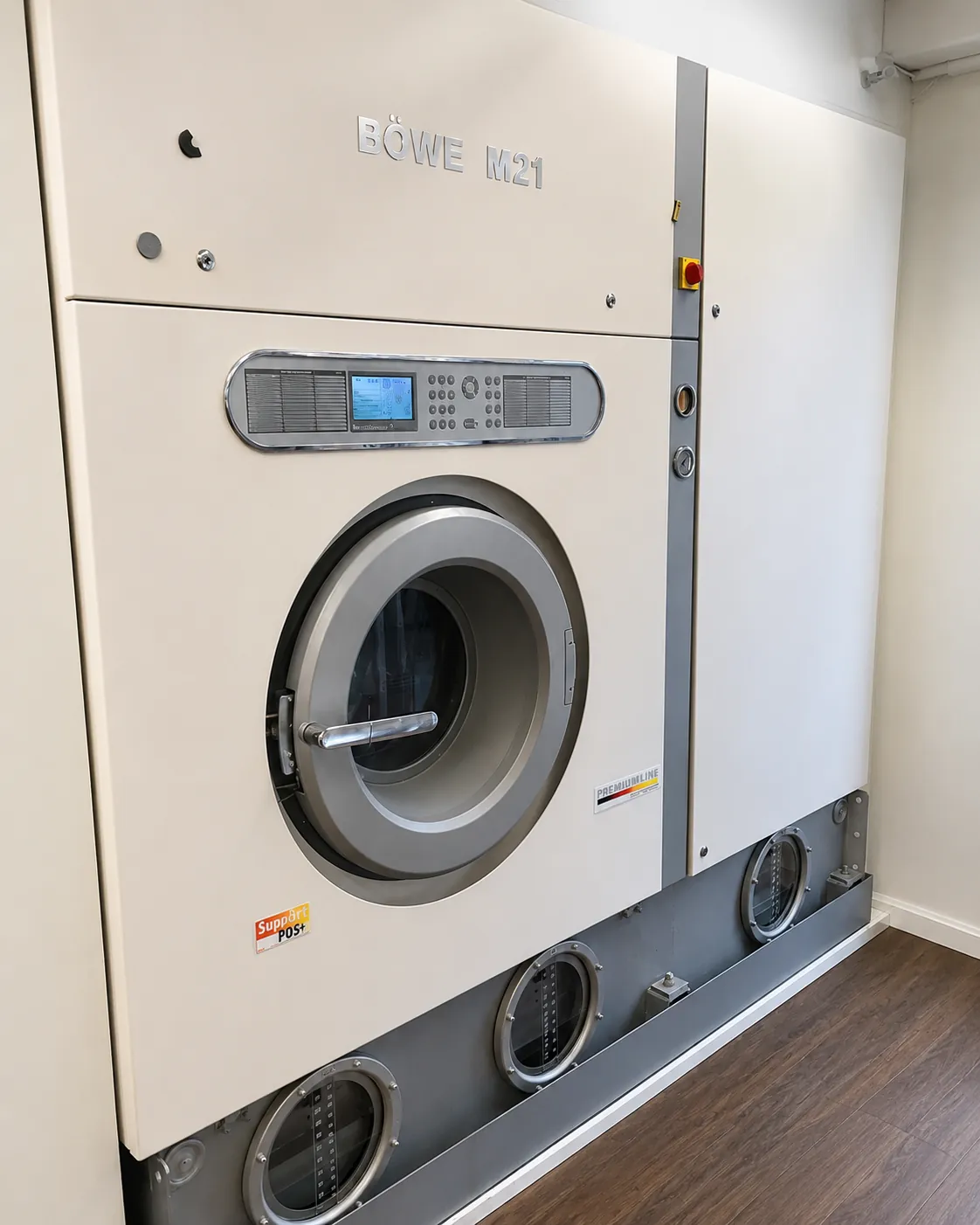
In many ways, dry cleaning is similar to ordinary washing. The clothes are sorted, placed in a drum and treated with a programme that suits them.
The big difference is the liquid.
A washing machine uses water. A dry cleaning machine uses a special cleaning solvent.
It may sound technical, but the principle is actually quite simple.
A dry cleaning machine resembles a washing machine
Before the clothes are dry cleaned, we sort them by colour, material and the treatment they need, among other things.
The clothes are then placed in the drum of the dry cleaning machine and cleaned together in suitable loads, much like sorting laundry at home.
The solvent moves through the clothes and helps remove dirt, grease and various types of stains.
There are different solvents. Today these include hydrocarbon-based solvents and perchloroethylene, often called PERC.
Dry cleaning or washing? It depends on the garment and the stain
Dry cleaning is not always the best treatment.
Some stains respond best to solvent, while others are best removed with water. The same applies to textiles. Some clothes are best suited to traditional dry cleaning, others to washing or professional wet cleaning.
That is why it is a great advantage for a dry cleaner to be able to work with several different methods.
We can choose between dry cleaning, washing and professional wet cleaning, and so select the treatment that best suits the garment's material, construction and the stains we need to try to remove.
Quite simply, it gives more options for treating different types of textiles and stains correctly.
Why can clothes that should not be washed be dry cleaned?
Water and solvent affect textiles differently.
Some materials can lose their shape, shrink or felt when they get wet. This can be particularly important for clothes made of several different materials.
Take a suit jacket, for example.
It is not just the fabric on the outside. Inside the jacket there is lining, interfacing, seams and other materials that together give it its shape.
That is why ordinary washing can be hard on the construction, while dry cleaning is often better suited to preserving shape and finish.
The same can apply to wool, silk, dresses, jackets and other delicate textiles, among others.
What actually happens in a dry cleaning machine?
In modern dry cleaning machines, the solvent works in a closed system. It is recovered, filtered and maintained so that it can be used again and again.
This means the solvent is not thrown away after each load.
In this respect the process is very different from ordinary washing, where the water is used and then becomes waste water.
With dry cleaning, by contrast, the solvent stays in the system and is reused many times. This means less consumption of new liquid and far less process water than with traditional washing.
Why is it called dry cleaning?
The name “dry cleaning” can be a little misleading.
The clothes do come into contact with liquid during cleaning. It is just not water that is used as the main cleaning agent.
In a modern dry cleaning machine, both cleaning and drying take place in the same machine.
The easiest way to picture it is as a washing machine and a tumble dryer built into one.
We put the clothes in dry. They are cleaned, the solvent is recovered, and the clothes are dried inside the machine.
When we open the door again, the clothes are dry.
And then the final part of the work begins
When the clothes come out of the dry cleaning machine, they are not simply finished and ready for the hanger.
Now they are checked and finished.
Depending on the garment, it may be steamed, pressed, ironed and finished by hand. This is where a suit gets its shape back, trousers get their creases and a dress gets the right finish.
The machine itself cleans the clothes.
But the finished result also depends on the work done before and after the cleaning process.
In short: what is dry cleaning?
Dry cleaning is the professional cleaning of textiles using a special solvent instead of water as the main cleaning agent.
It is a method particularly well suited to many types of clothing that can be sensitive to ordinary washing.
But a modern dry cleaner is not only about dry cleaning.
The combination of dry cleaning, washing and professional wet cleaning makes it possible to choose the treatment that best suits both the garment and the stain.
And that is really one of the most important things about a professional dry cleaner: knowing when to dry clean, when to wash and when to choose a different treatment.